jQuery Double List Box Control for WebFOCUS

Our IBI double list box control, unique to WebFOCUS, has a good user input experience. Most notably is how the control keeps track of the values selected in a visible manner on the right side. Here’s a screenshot of what I mean.

Our out-of-the-box control covers most use cases, but there are a few additional functions that would be useful including:

  • Having more than one column in the left box to provide more context of what is being selected
  • Sorting on individual columns to help find a selection in the left box
  • Searching on all columns to find specific selections in the left box
  • Visually indicating that a row has been selected in the left box rather than removing it
  • Total control of the look and feel of the double list box using CSS
  • Drag and drop row reordering of the right box

With that being said, I’d like to demonstrate what I created for a client. It’s a jQuery plugin that has been integrated with WebFOCUS. Normally, I would provide the source and example of how to use it in WebFOCUS; however, because of IP restrictions, I can’t share this plugin with you. Hopefully, this video will give you a sense of what I’ve accomplished with this plugin.

http://youtu.be/EoWg7oSmer0

If you’re interested in how myself or someone else at IBI can help you enhance the user experience of your WebFOCUS reports or dashboards, shoot me an email via LinkedIn. You can find me here.

Show Me the Numbers: The Good, The Bad, and The Ugly of LinkedIn Endorsements

I'm flattered when I get endorsed for a skill on LinkedIn. However, I'm perplexed when I'm endorsed by an individual whom I have neither worked for nor met. In addition, individuals who I have worked with are being endorsed for skills I know they do not have. This is unfortunate for LinkedIn because this removes any value that the endorsement feature could have had.

I understand the intent of LinkedIn Endorsements. It's a quick and easy way for someone to validate another's skill(s). In comparison, LinkedIn recommendations, at least genuine ones, requires significant time and reflection. As an example, although my recommendations are usually a short paragraph, I spend at least an hour to succinctly capture the best traits of the individual. How can LinkedIn clean up their mess?

Data Cleansing LinkedIn Endorsements

If LinkedIn wants to salvage this feature of their site, here's what I would do to clean up the existing endorsements.

  • Validate a member's credibility to give endorsements; a simple way would be to see how many endorsements the member is making that are NOT skills they possess. How can a person who does not do data modelling say that someone else's data modelling skill is worth endorsing? With this in mind, we can take these metrics and create

    1 - (number of endorsements of skills the member does not have / the number of endorsements made) = the credibility percentage

    Of course, this makes an assumption that the member truly possesses this skill. It's also an oversimplified way of determining someone's credibility but it's a start.

  • Choose a threshold that determines whether or not a person is credible. Let's say anyone with a credibility score of 80% or higher has provided a valid endorsement and significantly weight it. Weight it even more if the endorsement comes with a recommendation.
  • Those with a credibility score less than 80% could still have their endorsement count but weighted much lower.
  • Use both these counts to create a star rating with the number of endorsements and a breakdown between credible and less credible sources. For example, a person with a skill that has 67% endorsement from credible sources and 33% endorsement from less credible sources could get 3.5 stars.
  • Take it one step further and a skill becomes validated when there are more than 10 or more endorsements.


This is only putting a Band-Aid on the real problem though.

Stop Arbitrary Endorsements

Prevention of poor data will reduce the amount of work required to make the data meaningful. LinkedIn should consider putting a more rigorous endorsement process. At the minimum, only those with the skill can endorse others with the skill. In addition, the member's relationship to the endorsee should be considered. Only If they have worked together or done business together, should they be able to give an endorsement. It raises eyebrows when a friend endorses a fellow friend.

Recommendations Will Always Count More

I've suggested ways to prevent poor endorsements and how to give more meaning to endorsements. However, people should take the time to write recommendations if they truly care to help the person. In the meantime, LinkedIn should reconsider what the meaning of an endorsement is because right now, it is a lazy way to pat members of your network on the back. If you want to discuss more, here's an appropriate place to do it - this LinkedIn Discussion. :D

jquery Bread Crumb library for WebFOCUS reports

A common function of a WebFOCUS report is to drill down to another report or the same report with different parameters. Below is an example of a report that drills down to another report that takes the car brand as a parameter.


Figure 1. This is the report that shows all the cars and their lengths. The user can click on any of the car brands to drill down to more details.


Figure 2. This is the report after the person has clicked on ALFA ROMEO. It shows all the models for ALFA ROMEO

It’s straight forward to drill down but drilling back up is another story. There are WebFOCUS implementations that include implementing a back button. Really, it just calls the javascript function history.go(-1). Another option is to have parameterized links on the reports to navigate back to a selected value but it does take some planning to make this work properly.

A javascript / jquery alternative

I decided to take the approach of using a bread crumb trail to drill back up. In addition, I chose to use javascript / jquery because I know I could package it up into a clean library that requires only cutting and pasting a small code block (and a little bit of configuring).

Here’s what it looks like:


Figure 3. This shows the Home bread crumb


Figure 4. This shows the selected value bread crumb and the ability to click home

You can download the how-to file here.

Enjoy!

Adding Sparklines and Bullet Graphs to WebFOCUS using jquery library

I’ve been at Information Builders for almost 2 months and I have to say, I still feel like I’ve only scratched the surface of what our BI software, WebFOCUS is capable of. One thing I have been exploring is integration of javascript libraries into WebFOCUS reports.

I found a sparkline and bullet graph open source jquery library online. I thought it would be very useful in WebFOCUS reports. You can accomplish the same with WebFOCUS only (although I have not personally done it) but I really wanted to see how easy it was to integrate a third party javascript library.

It was pretty easy. :D

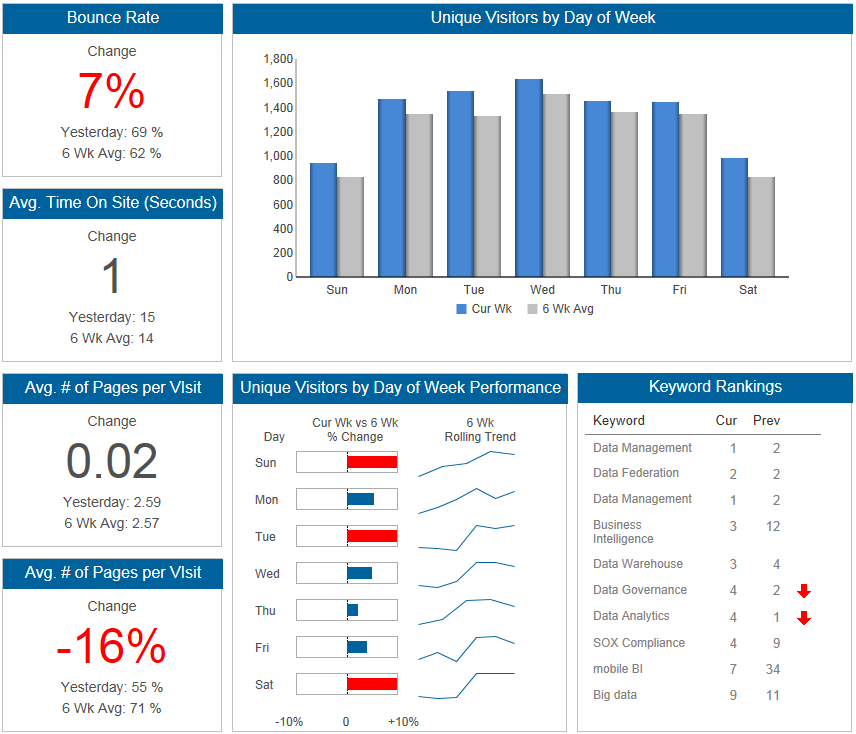
Here are the results of integrating sparklines, bullet graphs, and state indicators into a WebFOCUS report.

You can download the zip package that includes the example FEX file and a Read Me.

Download the zip package here. If you’re not familiar with the Google Drive interface, click on File on the top left and select the download menu item to download the file.

Cool beans, eh?

Understanding the Difference Between Performance Indicators (PIs) and Key Performance Indicators (KPIs)

I was planning to write yet another article on key performance indicators for Dashboard Insight because I felt Dashboard Insight needed an up-to-date reference for those who did not practice in performance management. I initially started writing the article, thinking I didn't need any reference material. I've lived through understanding, discovering, and refining measures for the last six years and I felt I could write it solely on experience.

Surprisingly, I had a hard time defining what a key performance indicator is without having to introduce more terms and, thus, more explanations.

Further reflecting on my experiences in business intelligence, I wasn’t sure if a simple explanation was possible. One person's performance indicator may be another's key performance indicator. For example, the number of leads by day would be a performance indicator for the CEO; however, for the marketing department, it may be a key performance indicator. The confusion doesn't stop there. Technically speaking, it could be a key result indicator for marketing - the number of leads is the result of all the activities marketing performs.

After much confusion trying to explain the difference between performance and key performance indicators (AND result indicators), I decided to step back and look at it from a different perspective.

Rather than fight through terminology, these are the questions decision makers need to ask themselves when choosing measures to look at:

  1. Is the measure clearly linked to an activity that I am responsible for?
  2. Does the measure support another measure to help in my decision-making process?

If the answer is no to both questions, than the measure is simply nice-to-have. There's nothing wrong with having these types of measures as part of your report or dashboard.

If you're not a performance management practitioner, you don't need to understand concepts like lead and lag indicators or result and performance indicators. Let the performance management consultants deal in those terms. Just remember to ask yourself these questions when you're given measures to look at and you'll know whether or not you need them to help support your decisions.

Many will question the simplicity of my explanation, but I believe that this is a good starting point for anyone who plans on working with performance management consultants.

From Dashboard Insight to Information Builders

It’s almost been a month since I started my new role at Information Builder’s as a Solutions Director and felt it was time to start up my personal blog again.

For my first post in many months, I thought it would be appropriate to talk about my experiences with Dashboard Insight and why I choose to move on to Information Builders (IBI).

Dashboard Insight gave me a unique opportunity to run a company without worrying about my financial situation. I learned a lot about web analytics, search engine optimization, and, most importantly for me, the business intelligence technologies out there. In addition, it gave me an opportunity to brush up on dashboard design and performance management.

One of the major events that I coordinated was the dashboard design contest. I am quite proud of the intent of the contest and the winning submissions. Hopefully, Dashboard Insight turns it into an annual event. I genuinely believe that I was on the right track of promoting data visualization and dashboard design best practices.

However, running a website is not my strength. Although I increased visitors by about 10% and I averaged about 100 twitter followers a month, I knew I was never going to reach the goals set by the owners. In addition, I was getting tired of talking about business intelligence and wanted to get back into developing BI solutions.

Those feelings led me to Information Builders. As a company that provides tools for the entire BI stack (master data management all the way to performance management), it was a company I could not say no to.

So here I am today, ready to start architecting BI solutions again. I’ve gotten myself familiar with our reporting tool WebFOCUS and I’m ready to dig deeper. I look forward to sharing my experiences with you.

Who knows, maybe I will be providing some dashboard design workshops in the near future. :D

Yahoo Email Traffic Data is Visualized

I found this interesting blog post that brought the following to my attention. Yahoo! Mail data is now readily available for people to see through their visualization site here. It's cool but I have a hard time understanding how to read the data.

For example, it's not clear what the size of the bubbles means. I'm guessing it represents the number of emails being sent. When I click on the bubble, I actually have no idea what the animation represents. When I click on one of the email images, it gets even more confusing. Play around with it and you'll know what I mean.

More importantly, what is an average user suppose to do with this data? It doesn't tell anything that I could use to better use Yahoo! Mail.

This visual analysis tool gets a 10 on the cool factor but gets a 1 for relevancy.

The first volley has been fired...

A couple of weeks ago I declared war on poor dashboard designs. Now, I've officially shot the first volley. I have been planning a dashboard design contest on Dashboard Insight for the last few weeks and now it is live. If you want to join my fight, then sign up for the contest. The winner will be featured on Dashboard Insight's home page and they will receive an iPad 2 and a collection of must read BI books. Our sponsors include Dundas, Tableau, QlikView, InetSoft, and XLCubed. They believe in the importance of this contest and I hope you show your support by entering.

70 Canadian IT execs answer three critical BI questions

ComputerWorld Canada recently did a survey on executives and their experiences with BI.

I don't like being snarky but I thought the questions that were asked to the 70 Canadian IT execs were not the right questions to ask. Here they are:
  • Do you have a standard BI platform across the organization?
  • Is BI critical to your organization?
  • Does IT spend a lot of time preparing BI data?
I think the first question is irrelevant. Does it really matter if an organization uses several tools? My answer is no, as long as they get the job done and it's not a maintenance nightmare for IT. In fact, some of the vendors that provide the entire suite don't usually live up to their claims, anyways. I.e. organizations are looking for additional tools such as data visualization software to complement an SAP or Cognos implementation.

The second question is important but too vague. If the respondent is unfamiliar with the concepts of BI, then the answer would be no. In fact, I would argue that everyone who took the survey does ask for data and analyzes it to some degree to make decisions. Maybe a better question would be, "Do you work with data to make decisions that affect the bottom line?"

The final question, which I think the question needs to be reworded, as well. What would be more interesting to know is how many of these respondents scrapped a BI project because of the latency in getting data to them.

Surveys are hard to design but to say that these are the 3 critical questions to ask is bold.

The Declaration of War on Poor Dashboards

On Thursday, I posted an Op Ed on Dashboard Insight declaring a war on poor dashboard designs. In the article, I gave suggestions on how to transition out requirements such as 3D charts and speedometers. This is just the first battle in this war. However, at the end of it, I believe we will win and bring a much needed new era in dashboards and business intelligence.

How can you help? Stay tuned until next Friday...
«May»
SunMonTueWedThuFriSat
2829301234
567891011
12131415161718
19202122232425
2627282930311
2345678